Book Review
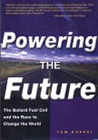
POWERING THE FUTURE:
The Ballard Fuel Cell and the Race to Change the World
by Tom Koppel

Publisher: John Wiley & Sons; 1 edition (September 29, 1999)
ISBN: 0471644218 In-Print Editions: Paperback
Hardcover: 288 pages
Dimensions (in inches): 0.93 x 9.24 x 6.25

by Philip S. Wenz, Editor/Publisher
A hand full of people can change the world, and, indeed, they often have. Sadly history can only give those changes negative, or mixed reviews. The Russian Revolution comes to mind, or the little cadre of people that turned the democratic Weimar Republic into the Third Riech. For the industrial revolution side there was Henry Ford who gave us wheels but also, indirectly gave us sprawl, global warming and endless conflict over oil.
Thanks to a handful of visionary engineers and businessmen, the planet is about to undergo a change that is perhaps more profound than that of all those wrought by the innovators above put together—and far more positive. Led by Canadian geophysicist-turned-engineer Geoffrey Ballard, the team took an almost- forgotten Hydrogen Fuel Cell (HFC) technology and turned it into the engine that will soon dominate the transportation industry. Powering the Future is the story of those visionaries and their two-decade struggle—equipped and capitalized, often, with little more than raw guts and determination—to keep their business running while overcoming the technological barriers that had caused dozens of alternative fuel engines to be stillborn.
The book is instructive not just because it describes the "alternative," fuel cell technology, which will soon become the mainstream technology, but also describes the alternative business atmosphere created by Ballard and his associates that encouraged innovation and almost fanatical devotion to the company's mission. It is the story of engineers and technologists working through many a night and weekend, and often taking home just a portion of their paychecks. It is the story of the triumph of delegation and democracy over centralization and bureaucracy in business. It is also the story of people—full of antidotes, jokes and life. Finally, it is the story of success against incredible odds—truly free enterprise at its best.
Ballard's first lab was a deserted motel on the Mexican-American border he bought for $2,000 and remodeled into a research facility. By the time he retired from the multi-million dollar Canadian company that bears his name, and holds a number of fundamental patents for fuel cells and other innovative technologies, Ballard Fuel Cells had partnered with Ford and Dalmier-Chrysler. Both automotive giants plan to put commercial HFC cars in the showroom and on the road by the end of this decade. As the principle manufacturer of the equipment for powering tomorrow's vehicles, Ballard has positioned itself to be the Intel of the transportation industry.
Powering the future is not only a good read, it is an inspiration for beleaguered designers struggling to bring their own gift to the world.